Monday, May 25, 2015

Tuesday, April 7, 2015
Guide to Collecting Weller Silvertone Pottery
Introduction
It is known that the S.A. Weller Company produced the Silvertone line throughout the 1920's in Zanesville, Ohio. Unfortunately, a full list of all shapes and designs are yet to be discovered. It seems like every year a new and unknown piece comes to light, sparking interest in collectors everywhere. There are over 30 shapes known, and many more designs, making it challenging and fun line to collect.
 |
| Weller Silvertone Calla Lily Vase |
Silvertone designs
The backgrounds are typically textured in shades of grey, blue, and white, creating aesthetically pleasing palette for the many designs that adorn them.The various flowers found on Weller Silvertone include calla lily, daisies, hydrangea, irises, roses, cherry blossoms, magnolia, chrysanthemums, dogwood, thistle, poppies, lilies, and more. The calla lily, daisy, and roses appear more common, while dogwood and thistle appear less often. Occasionally pieces are found decorated with butterfly's or other garden insects, and are considered rare. All of the Weller Silvertone pieces are hand painted with a semi-matt glaze. The shapes run the full gamut, including vases, baskets, bowls, compotes, candlesticks, baskets, flower frogs, and wall pockets.
 |
| Weller Silvertone Basket with Magnolias |
Marks and Tags
Weller Silvertone is never impressed in the base clay with a Weller mark or signature. Silver foil labels were often applied at the factory identifying it as a Weller product, but these labels have usually fallen off and disappeared over the intervening decades. In rare instances pieces can be found with artist signatures or initials under the glaze in an inconspicuous place, usually very small, but never on the bottom of the foot.
 |
| Weller Silvertone Vase with Poppies |
What makes a piece exceptional?
Collectors of Weller Silvertone are a rather picky lot. It is very difficult to sell nearly any piece of Weller Silvertone if it is damaged or repaired. Likewise, the glazes used were quite resilient, and not very susceptible to crazing. Crazed pieces will only command a fraction of the value of an uncrazed piece. Also, being a very picky group, they pay more attention to the sharpness of the mold than collectors of most other pottery. When the molds are first used, the designs are crisp and sharp, and as more and more pieces are produced the designs slowly get blurred and less defined. Collectors seek out those with sharp molds and brilliant colors, as well as unusual shapes and designs.
Conclusion
Collecting Weller Silvertone, or any other Vintage Weller Pottery can provide an amazing display in your home or office, and it can be quite challenging. For decades after such pottery fell out of favor it was often just thrown in the trash when moving, or sold at flea markets for 5 or 10 cents. It was considered almost disposable, and so often it was simply disposed of. It was not until the 1990's that collectors rediscovered Weller pottery lines, and now these pieces can be rare and difficult to obtain. Prices have been steadily rising for this interesting and collectible line, as more and more vanish from the market into private collections. For more information on Weller pottery, visit the online Weller Pottery resource page, or join the Weller Collectors Group.
Friday, March 13, 2015
Roseville Pottery Proper Color Names
Most of the Roseville Pottery lines from around 1930 until they closed in 1953 came in three distinct color themes. They are often referred to by the main background color such as Red, Pink, Blue, etc. However, unknown to many collectors, around 1940 Roseville began giving proper names to the colors, and expressed them in advertisements. Below is a short list of 15 pottery lines and the color names as given by Roseville.
White Rose 1940 Coral Autumn Brown Sea Blue
Columbine 1940 Red Sand Brown Frost Blue
Bushberry 1941 Blue Green Orange
Peony 1942 Coral Sienna Brown Nile Green
Water Lily 1943 Rose Walnut Brown Ciel Blue
Clematis 1944 Forest Green Autumn Brown Ciel Blue
Freesia 1945 Tangerine Delft Blue Tropical Green
Zephyr Lily 1946 Sienna Bermuda Blue Evergreen
Snowberry 1947 Dusty Rose Persian Blue Fern Green
Apple Blossom 1948 Coral Aqua Blue Apple Green
Wincraft 1948 Apricot Azure Blue Chartreuse
Ming Tree 1949 Temple White Jade green Celestial Blue
Artwood 1951 Stone Gray Poppy Yellow Emerald Green
Bittersweet 1951 Dawn Gray Marsh Green Saffron Yellow
Capri 1952 Cactus Green Metallic Red Sandlewood Yellow
Raymor was introduced in 1952 with five colors: Beach Gray, Terra Cotta, Avacado Green, Autumn Brown, and Contemporary White. They later added Burmese (Black), Spring Gray, and Gold.
This list can be very useful when you have Roseville Pottery for sale. Having the ability to identify the correct color name makes you appear more knowledgeable about the pieces you wish to sell, and increases the chance of a sale. If you discover other given names, please let us know so that we can expand this list.
 |
| Ming Tree Ad listing proper color names. |
Monday, March 9, 2015
Roseville Apple Blossom Experimental Prototype 385-8
In 1948, the Roseville Pottery Company introduced their Apple Blossom line. There were 45 shapes listed in the catalogs, in three color schemes: Coral, Aqua Blue, and Apple Green. It was produced for several years, and is considered a common later period line with moderate collector interest. They can easily be found in many antique malls, flea markets, and auctions, and the pieces generally do not command very high prices. This makes it a good entry-level pattern for collectors looking for Roseville pottery for sale.
When creating a new line, Roseville Pottery would first produce a range of variations in both shape and color scheme, usually only one of each variation, and then go through a process of determining which color scheme or design to use. These "one-off" pieces were never made available for sale, and most were destroyed. They were simply test pieces that at the time had no value. This article will examine once such item, a prototype vase from the Apple Blossom line, 385-8.


When creating a new line, Roseville Pottery would first produce a range of variations in both shape and color scheme, usually only one of each variation, and then go through a process of determining which color scheme or design to use. These "one-off" pieces were never made available for sale, and most were destroyed. They were simply test pieces that at the time had no value. This article will examine once such item, a prototype vase from the Apple Blossom line, 385-8.


The picture on the left is an experimental prototype for the 385-8 shape, and the picture on the right shows the vase as produced in 1948. Note the brighter color of the background glaze, the richer details on the flowers, as well as the additional leaves and buds. Also, the flowers are yellow with pink details on the prototype, whereas the production vase displays simply white with coral centers.
On the reverse, the differences are even more striking. Instead of just a simple pair of flowers, there is a large flourish of them, and an addition of several more leaves.We may never know the reason why the choice was made to reduce so many components of the design, but it was likely done to keep production costs lower. Regardless, the actual production piece looks clumsy by comparison.
On the base we find the expected "Roseville USA" and the shape number 385-8, but also additional annotations written in crayon under the glaze. The 8-34-108 are probably the colors used on this piece, and the 407 6038 might be the trial designation. Also in very small pencil letters is a catalog number from a rather large collection, the Monsen-Baer collection. This piece is likely unique, and was last sold at a Humler & Nolan auction on March 7, 2015. Any collector of the Roseville Apple Blossom pattern would be proud to display such a rare and important piece in their collection, but in the end, only one collector can.
Sunday, February 8, 2015
Collector Guide to Fenton Opalescent Coin Dot
 |
| Four of the five Fenton Coin Dot colors. Which one is missing? |
Introduction
The Fenton Art Glass
Company was founded in 1905, and is still in business today. They produce very
limited quantities of art glass, but in their heyday they were considered a
household name. Fenton glass was a staple of American household decor for decades
before cheap imports from the Pacific rim in the 1970's nearly drove them to
bankruptcy. Throughout their history they produced a wide variety of glass
wares, from the mundane to the exquisite. There are Fenton collectors for
nearly every style and design produced, with some pieces commanding high prices
due to relative rarity, and others available for just a few dollars.
One of the most popular of the vintage lines
with high collector interest is the Opalescent Coin Dot. It first appeared in
the catalogs in 1947, and some types are still being re-issued today. It is
technically a copy of a Victorian glass pattern known as "Polka-Dot",
but Fenton displayed it's flair with their own unique shapes. The Victorian
pieces are easily identified by having a polished pontil, whereas Fenton pieces
do not. The Victorian pieces are nearly impossible to find, but the Fenton
pieces sell every day at auctions, flea markets and online stores. With a
variety of colors and shapes, the Opalescent Coin Dot line can provide collectors
with a stunning display.
The Five Opalescent
Colors
Most of the Fenton Opalescent Coin Dot pieces
have a single basic commonality; they each are composed of a colored glass
cased in a milky-white French Opalescence. The only exception is the Green and
Lime Opalescent line. The 1947 Coin Dot catalog outlines the original three
colors, and the other two were added later. There are still persistent rumors
of test pieces made in additional color combinations, but as yet none have been
verified.
 |
| Cranberry Red Coin Dot, shape #1925 |
Cranberry Red
Opalescent Coin Dot
Showcased in the 1947 catalog, Cranberry Red
was by far the most popular, and remains so today. The original 27 shapes were
supplemented over the years, and the Cranberry Red was produced steadily until
1964. Fenton reintroduced the line in the 1980's but the colors were more
muted. The reissued pieces are easy to identify because they bear the
"Fenton" name impressed in the bottom of the base, whereas the original
pieces were unmarked. The Cranberry Red color was created by mixing gold into
the glass, and so was a bit more expensive to produce than the other colors.
 |
French Opalescent Coin Dot shape #189.
|
French Opalescent Coin
Dot
Also in the 1947 catalog was the French
Opalescent Coin Dot, a milky-white over clear glass. It produced an amazing
effect where each of the dots reflected several of the others like a lens,
giving it the illusion of having a multitude of dots within each dot.
Production on this color ended in 1950, making it far less common than the
Cranberry Red. It is difficult to find, but can be dazzling to display with the
correct lighting. Collector interest in this line has been rising steadily,
partly because theirs pieces can accent just about any decor. Over the years
they have become harder and harder to find.
 |
| Blue Opalescent Coin Dot, shape #194. |
Blue Opalescent Coin
Dot
The third color in the 1947 catalog was Blue
Opalescent. The french opalescent casing covered a very pale blue body, and did
not provide a great deal of contrast. After 1950, various shapes began to be
dropped from production, until in 1954 the entire color was discontinued. The
color did not sell well compared to the others, and even today collector
interest is lukewarm. However, the supply is rather limited as well so they can
sometimes be rather pricey to obtain.
 |
| Honeysuckle Coin Dot , shape #203. |
Honeysuckle Opalescent
Coin Dot
In 1948, Fenton released a new color of
Opalescent Coin Dot called Honeysuckle. With french opalescent over a light
amber core, it did not sell well at all, and was only produced in 1948 and
1949. Honeysuckle is quite hard to locate and although collector interest is
fairly low when compared to the more common colors, these pieces can command
high prices when they come to auction.
 |
| Lime and Green Coin Dot, shape #454. |
Green and Lime
Opalescent Coin Dot
In 1952 Fenton produced the final color, the
Green and Lime Opalescent. Produced until 1954, it is the pariah of the
Opalescent Coin Dot. It was initially released with a pale blue casing instead
of the milky french opalescent. The core was a bright lime color, creating a
clashing and very busy-looking image. This was changed within the first year
back to the standard french opalescent casing. Dealers sometimes see this color
and assume it is uranium glass or Vaseline glass, but it is simply green glass
because the production of uranium and vaseline glass was illegal in the United
States between 1943 and 1958. All of the Green and Lime Coin Dot was produced
during this ban. Finding these pieces can become a lifetime journey as the line
was a financial failure with very poor sales. The few surviving pieces cased in
blue are in private collections and rarely come up for sale.
Care of your Fenton
Glass
There are a wide
variety of chemicals and cleaners that can be damaging to most glass, and this
especially true of Fenton. Improper exposure to many common cleaners over time
can cause the clarity to suffer, a condition often referred to as "Sick
Glass".
Warm, soapy water and clean cloth are the best
friends a piece of Fenton art glass can have. Never use kitchen cleaners,
vinegar, bleaches, or ammonia. Lightly clean in warm, soapy water, rinse with
warm water, and dry with a lint-free cloth and your Fenton art glass will
remain brilliant and beautiful for generations to come.
Conclusion
Collectors of vintage Fenton art glass are almost universally aware of the Cranberry
Red and the Coin Dot, and any auction that features them will fill the house
with bidders. However, being knowledgeable about the variety of Coin Dot colors
and shapes available give collectors an opportunity to expand the range of
their collections. A Coin Dot collection should display as many of the five
colors as possible to provide a visual experience that is far superior to just
the common Fenton Cranberry.
Perhaps there is a Green and Lime piece at the next auction just waiting for
you!
Sunday, February 1, 2015
Collector Guide to Roseville Pottery Zephyr Lily Pattern

Roseville
Zephyr Lily vase 135-9
Introduction
The Roseville Pottery created ceramic art
pottery from 1892 until 1954, most of that time in Zanesville, Ohio. They
produced many lines that sold across the country and abroad, and were a
household name for over 50 years. For decades after their bankruptcy, Roseville
pottery could be obtained for almost nothing at flea markets and garage sales,
with most pieces selling for less than a dollar each. In the late 1970's, a new
generation with a nostalgic attitude began collecting vintage Roseville Pottery they remembered
from their parents, and a new hobby was born. Prices reached amazing heights in
the turn of the new century, but crashed around 2003 when the internet made it
easier to find and obtain previously scarce pieces. With prices now much more
reasonable, it is much easier to put together a respectable collection. We will
examine the Zephyr Lily pattern, a very common and popular line that has a
strong collector base as well as supply.

Evergreen Zephyr Lily vase 206-7

Sienna Zephyr Lily vase 206-7

Bermuda Blue Zephyr Lily vase 206-7
The Zephyr Lily Colors
and Marks
The Zephyr Lily
pattern was first introduced by Roseville in 1946, and is considered a late
period line. Roseville had for decades produced line after line, each named for
a particular flower, and in a variety of colors. They generally used three sets
of two colors each, and this served two purposes. The first was to ensure that
no matter the color theme of a customer's decor, they would have something
which would match. Secondly, they provided a seasonal feel, so that a customer
could change out their decor with the changing of the seasons.
The Zephyr Lily
pattern came in three distinct color themes. There is the "Bermuda Blue", designed for summer, which transitions from a very deep blue to a
pale blue, there is Sienna, designed for fall which transitions from a
burnt sienna to a pale orange, and there is "Evergreen", designed
for spring which transitions a very dark green to a pale light green. The
flowers themselves came in four colors, white, yellow, rose, and lavender. While
there appears to be no system which will predict which colored flower will
appear on a particular piece, the same shape with the same background colors
will always have identical colors for the flowers that every other one does. A
piece may have four flowers, each a different color, but so will every other
piece of the same mold with the same background color. No other background
colors or flower colors were ever used, so if you find a vase with a white
background and purple zephyr lily flowers you have a problem.
Each piece of Zephyr
Lily has raised marks on the underside reading "Roseville",
"USA", and a shape number. There are a few exceptions, such as the
ashtray which is unmarked. The second part of most shape number is an
approximate size of the largest dimension in inches. It was not unusual for the
actual measurement to be off by a half inch either way, but since the pieces
were molded, if one particular vase was off by a half an inch, then all of them
with the same shape number were.
Roseville Zephyr Lily Shapes
According to Roseville
records, there were 51 different shapes offered for sale. Considering that each
was done in all three background colors, it comes to 153 unique pieces for a
collector to obtain. The following is a list of the known shape numbers:
393-7 basket
394-8 basket
395-10 basket
470-5 bowl, tall 2-handles
471-6 bowl, tall 2-handles
472-6 bowl, low
473-6 bowl, with pedestal base
474-8 bowl, low
475-10 bowl, console
476-10 bowl, low
478-12 bowl, console
479-14 bowl, console
1162-2 candle holder
1163-4.5 candle holder
8-10 compote
5-8 cookie jar
203-6 cornucopia
204-8 cornucopia
7-C creamer
22-6 ewer
23-10 ewer
24-15 ewer
672-5 flower pot
472-5 hanging basket
671-4 jardiniere
671-6 jardiniere
671-8 jardiniere
671-8 pedestal
477-12 tray
478-14 tray
130-6 vase, 2-handled
131-7 vase, 2-handles on base
132-7 vase, 2-handles on base
133-8 vase, 2-handles on base
134-8 vase, urn, 2-handles on top
135-9 vase, 2-handles on sides
136-9 vase, 2-handles on base
137-10 vase, 2-handled
138-10 vase, 2-handled
139-12 vase, 2-handles on base
140-12 vase, 2 handled
141-15 floor vase
142-18 floor vase
201-7 bud vase
202-8 vase, urn, 2-handles on top
205-6 vase, "V"-shaped
206-7 vase, three holes in top
1297-8 wall pocket
1393-8 window box
*The ashtray is
unmarked

Fake
Zephyr Lily. Note the almost uniform color of the background, and crude
painting of stems and leaves.

Correct
raised marks. Note the yellowish color of the unglazed circular heel.
Spotting Damage,
Repairs, and Fakes
In it's heyday,
Roseville Zephyr Lily pieces could command amazing prices, and so naturally
many damaged pieces were repaired. It used to be easy to spot these repairs
with a black light, but today materials are used which can fool that test. When
examining a piece, always remember that the Zephyr Lily pattern has a dull
finish. If if has a glossy and high-shine finish, it has probably been
over-sprayed. Zephyr Lily can be safely cleaned with warm soap and water, and
many times this over-spray will peel off when being cleaned like a snake shedding
it's skin. You can also safely use common kitchen cleaners such as 409 that
will cause many repairs to melt off. You can also scrub them lightly with a
non-scratch scrubby pad, but never use metal steel wool or SOS pads. If there
are repairs they will usually just peel right off with light scrubbing. Don't
kid yourself: a very large percentage of the time when people sell pieces
"as-is" they are repaired. We have been to auctions where there were
dozens and dozens of Roseville pieces, and found every single one to have been
repaired. Although a practiced eye can usually detect the repairs with a bright
light and magnification, even the best get fooled occasionally. Always purchase
from dealers with strong reputations who will accept returns.
For the last 20 years
there have been Zephyr Lily reproduction pieces produced in China available on
the market. They cannot fool a practiced eye, but can certainly fool the
novice. The first clue is that on the bottom, the clay will usually be a
brilliant white instead of the yellow Ohio clay. The second clue is that the
colors are usually off by quite a bit, as are the details. Lastly, the
"Roseville" signature on the bottom is not correct. They pop up here
and there at auctions, but most collectors see them immediately for what they
are. We see them less and less as most auction participants call them out for
what they are, but be aware they do exist.
Always look carefully
at pieces for chips, cracks, and damage. A small "fleabite" can be
the difference between a great piece and one that is almost valueless. Check
the edge of the base all of the way around, the rim at the top, and try to look
inside for any cracks. Then examine the edges of the handles for chips, and
especially cracks where handles meet the main form. The ones that we usually
miss are on the flowers themselves, but the Zephyr Lily pattern has smoother
flowers than most so they rarely get damaged.
The Zephyr Lily
pattern seems to be nearly immune to crazing, we rarely see crazed pieces come
up. I would steer clear of any crazed piece since there is an abundance of
uncrazed pieces available.
Many patterns such as
Pinecone were run in molds so many times that you can find examples with nearly
every detail smoothed. This is known as "bad mold" or "poor
mold". While in the Zephyr Lily pattern some molds are sharper than
others, I am yet to see a produced piece that I would consider a "poor
mold". They must have become more diligent in changing the molds in the
1940's, so this is not normally a concern with this pattern.
Conclusion
The Roseville Pottery Zephyr Lily pattern is popular with
collectors, and armed with a little knowledge it can be a fun collection for
you as well. Take your time, learn about the shapes and the colors, learn to
spot the bad apples, and you will soon amass a beautiful collection to be proud
of!
Tuesday, January 27, 2015
Guide to Collecting Early Rookwood Pottery
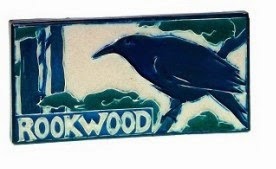
Early
Rookwood Pottery advertising tile.
Introduction
The Rookwood Pottery Company was founded in
1880 by Maria Longworth Nichols in Cincinnati, Ohio. Since their inception, the
company continued to produce innovative art pottery for over 100 years. Always
striving to stay ahead of current trends, their styles changed with the times,
new lines being created and old ones being retired. Although they created an
almost mind-boggling assortment of pieces, most collectors know very little
about the earliest of Rookwood art pottery. In this article we shall explore
the various lines, styles, and artists who created these early wares, and help
set Rookwood Pottery on it's journey.

Early
Limoges Rookwood pottery vase with fish.
Limoges and Cincinnati
Faience
When the Rookwood Pottery began, they were
considered the primary innovator of under-glaze painting, which is a process of
applying various colored clay as a palette and painting it onto a piece of
pottery before applying the final glaze. Their early work was referred to as
both "Limoges" from the region in France which had pioneered the
process, and as "Cincinnati Faience" in an attempt to differentiate
it. The Cincinnati Faience style was usually produced on hand-thrown pieces,
often carved and incised, with very thick decoration under the glaze. Some
people refer to this work as "Halloween Rookwood" due to the subject
matter, which often shows various grotesque insects, birds, dragons, fish,
bats, spiders, spiderwebs, and nets. Nearly all of this thick, heavy
under-glaze was created by Maria Longworth Nichols and Albert Humphreys,
although Helen Peachy and several other members of the Cincinnati Pottery Club
are known to have produced some. Very often there is added gold gilding above
the glaze to highlight details. Collectors of Limoges face a daunting task, very
little has survived outside of museums, and pieces by the founder of Rookwood
often come with a hefty price tag. She produced very little after 1883, so this
date is usually assumed as the end of the Rookwood Limoges line.

Lovely
Japanesque Rookwood miniature perfume jug
Japanesque
The addition of several new artists refined
the subject somewhat, adding sparrows, bamboo, owls, and other popular themes
providing a more delicate design. Much of the artwork was taken from various
Japanese texts, and as such is usually referred to as the "Japanesque
Rookwood". The artwork is generally considered not to be a replication of
Japanese style, but more of an interpretation of what Americans thought
Japanese art was at the time. Most of the Japanesque pieces were decorated on
molded pieces, and often on such mundane things as porridge bowls or ginger
jars. Matthew Daly, Joseph Hirschfeld, Martin Rettig, Alfred Brennan, William McDonald, Hattie Horton, Laura Fry, Clara Newton, and Albert Valentien
pioneered these Japanesque styles, mixing various sparrows, butterflys, owls,
cloudy skies, landscapes, bamboo, and floral themes. Many of the artworks were
originally standardized, with all of the artists decorating pieces with the
same image, and they all appear nearly identical. However, very quickly each
artist began developing their own styles and repertoire, expanding the variety
of artwork available. Pieces by Daly and Valentein are considered slightly more
collectible than the other artists in the Japanesque style, but they are
generally not considered much more aesthetically pleasing than the others.
Collectors of Rookwood Japanesque art pottery tend to pay less attention to the
artist and more attention to the overall rarity of the piece and the subject
matter. Most of the the early themes disappeared after 1885 and were replaced
almost completely by floral compositions. This tradition continued somewhat
with the cameo and dull glaze lines, well into the 1890's.

Early
Rookwood vase carved by Harriet Wenderoth.
Incised and Carved
A third, and very
overlooked early style was the production of pieces which were not decorated
under-slip with colors, but instead were carved and incised. Various artists
with talent in woodcarving as well as young schoolgirls were given the
opportunity to decorate pieces and used a variety of methods to produce them.
The simplest methods used nail-heads or dies to create repeating patterns on a
piece of pottery, but some produced very intricate and delicate carvings. Fanny Auckland, William Breuer, Katherine deGolter, Agnes Pittman, and Harriet Wenderoth each have their own unique style, but those pieces which were
hand-carved rather than impressed tend to have a better appeal to collectors.
One notable exception is Ms. Auckland who has found quite a following among
collectors. By 1883 the production of these carved and impressed pieces
vanished, and carved pieces were rarely manufactured again until the Arts and
Crafts period decades later.
Conclusion
Often overlooked by experts, the early Rookwood art pottery lines can provide a rich experience for
collectors looking for unique and interesting pieces to display. Whether it is
the heavy and often grotesque Limoges style of the founder, the delicate
Japanesque style of the early artists, or the true roots of Art and Crafts in
Cincinnati, there is something for everyone. Most major auctions will have a
few such pieces, and collecting them can be a challenging and life-long
endeavor. Aside from auctions, there are many sources on the internet where you
can find Rookwood pottery for sale, although few have the art
pottery desired by collectors of the early works. Now that you know what to
look for, it is time to get out there and find them! Learn more about Rookwood Pottery at the Rookwood Collectors Group.
Subscribe to:
Posts (Atom)